


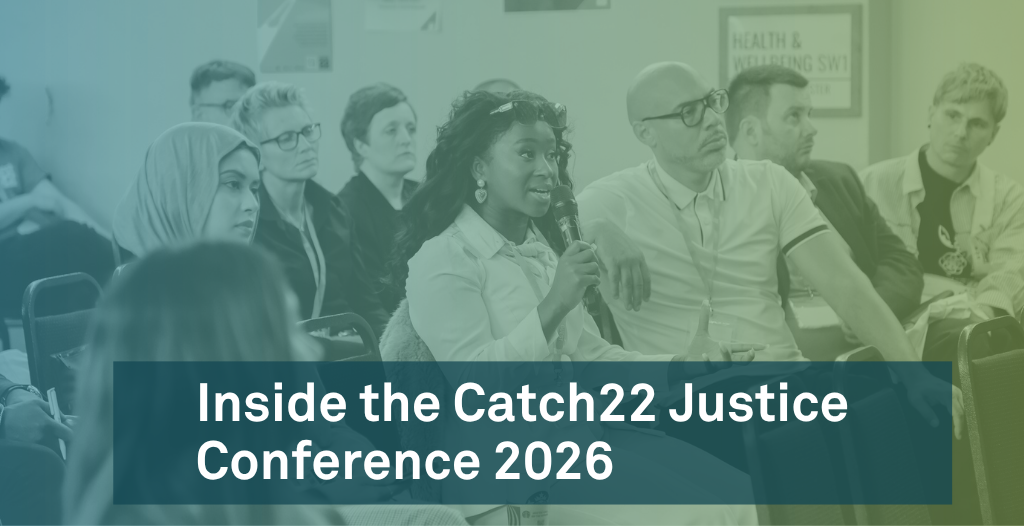
Last week, more than 170 people from across the criminal justice sector joined us at the Catch22 Justice Conference. Commissioners, practitioners, partners, funders, policymakers and people with lived experience came together.
The day focused on the role of the third sector in criminal justice, and how we can continuously learn to ensure we’re improving outcomes for people in a system under pressure.

We made a deliberate choice not to shy away from the challenges the sector faces. From prisons over capacity, a probation service stretched thin, shifting patterns of crime, and court delays that leave victims and people on remand waiting far too long for resolution, the people in the room work in this system every day and understand the pressures well.
The day was anchored in one of the central pillars of our Mission 2030 strategy: continuous learning. We believe that improving outcomes for the people we work with depends on the sector’s ability to learn from one another, share evidence, and adapt practice in response to what works.

This sector is also a large and dispersed one, spanning organisations across the country and the full breadth of the justice system, from victim services through to resettlement.
One of the challenges of working in a sector this size is that it can be hard to feel connected to those doing related work alongside you.
Bringing colleagues into one room, particularly the grassroots organisations whose work so often goes underrepresented in national conversations, is one of the most valuable things this kind of event can do.
The value of that shared space came through clearly in attendee feedback. As one attendee put it, “the Catch22 conference was an invaluable opportunity to make connections, gather thoughts and spark ideas with others who really want to do more for people in our criminal justice system.” Another described it as a chance for “connecting with so many great partners and hearing so many valuable insights.”
Honest about the challenges, but focused on what works
The theme running throughout the day was the relationship between two things: the very real pressures facing the system, and the sector’s determination to keep improving outcomes despite them.

Across the sessions, one question repeatedly came up – how do we respond to these challenges well? That focus shaped the topics we explored, including co-production and the role of lived experience, the importance of early intervention, and the responsible use of AI.
Keynote speakers
Our two keynote speakers set the tone. Martin Jones CBE, HM Chief Inspector of Probation, and Stephanie Roberts-Bibby, CEO of the Youth Justice Board, both spoke honestly about the strain the system is under.
For people working within that system day to day, hearing those pressures acknowledged openly by leaders in their positions carries real weight. Both speakers were also clear and ambitious about what the sector can achieve.
One attendee described the keynotes as “incredible,” singling out “the head of the probation service being so brutally honest about the probation service” as a particular highlight.
Breakout sessions
We ran eight breakout sessions over the course of the day, each one bringing together expertise from across the voluntary and statutory sectors:
- Place Based Delivery: Building Locally Integrated Justice Services
- Catch22 Collaboration Studio: Understanding how we create the conditions to co-create, co-design and co-produce
- Collaborating for Impact: VCSEs as Social Value Partners in the Justice System
- Violence Reduction: Breaking Cycles of Harm in Custody & Community
- Children & Young Adults: What does a transformed system look like?
- Beyond Delivery: Voluntary Sector Organisations as System Leaders
- What does effective resettlement require in 2026 and beyond?
- AI: From Hype to Adoption
Attendees told us that the topics felt timely, and that the range of voices in each session brought real depth to the discussion.
Catch22 collaboration studio
In this session Carl and Lauren shared both their professional expertise and their lived experience of why meaningful collaboration matters.
They were clear about what good collaboration requires in practice: creating safe spaces, avoiding tokenism, and involving people from the start of a process rather than as an afterthought.
An audience member asked how being invited to collaborate can support someone into employment following a conviction, which prompted a valuable
discussion, and another attendee with lived experience spoke up to recognise the strength of Carl and Lauren’s contributions. Ensuring that collaboration with people with lived experience is done in the right way matters a great deal to us, and it is why the programme exists.
Children and young adults: what does a transformed system look like?
This session considered what a genuinely transformed justice system might look like for this cohort. We were delighted to be joined by Annmarie Lewis OBE, Head of Criminal Justice at the Barrow Cadbury Trust, Race Equity Associate at the Youth Endowment Fund, and lead of the Young Adult Justice Transformed project.
Participants were encouraged to reflect on how the current system continues to see young people with multiple unmet needs move through it, and what a more considered approach could look like instead. Annmarie’s full reflections from the session have since been published by the Barrow Cadbury Trust. Read the report.
The AI: from hype to adoption session
This session explored how technology can help address some of the challenges the sector faces. Good Tech and Justice Ops shared the ventures they have been developing, including ReintegrateME, an employment platform that connects businesses with a talented and often overlooked workforce of people on probation.
It brought together lived experience experts, commissioners, employers, founders and frontline practitioners to discuss what it takes to make technology solutions work in practice, including building accessible tools that staff and service users can trust and understand.
Collaborating for impact: VCSEs as social value partners
This session brought together the Social Value Portal, the Mitie Foundation and the London Violence Reduction Unit to examine the challenges justice-focused charities face around social value in tender responses.
A key takeaway was that social value delivers most when it brings genuine additional benefit to local communities, the opportunities for third sector organisations to act as social value partners to corporates, and the importance of recognising the expertise and impact those organisations bring.
Justice delayed, justice denied: unpacking challenges and solutions
The afternoon panel discussion on court backlogs was widely picked out in attendee feedback as a highlight, with one attendee describing it as “very informative and thought provoking.” Others noted the “diversity of the attendees,” the “variety of topics and contributions,” and the way the conference brought together a “broad range of organisations” working towards shared goals.
Learning from one another
What ultimately made the day work, was the people in the room. Professionals from across the voluntary and statutory sectors, funders, policymakers and people with lived experience created an environment in which expertise could be shared openly.

Thank you to everyone who joined us, and to those who were unable to attend this time, we hope to see you at a future event.
We look forward to continuing these conversations, and to learning from one another as we work towards a justice system that is fairer, more evidence-led, and more innovative.