


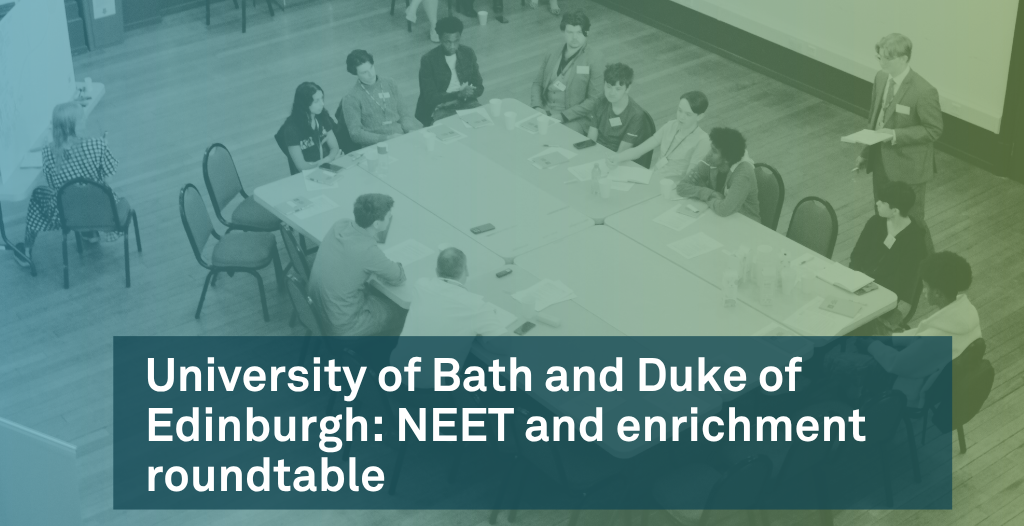
Last week, Catch22 was invited to attend a roundtable discussion with practitioners and young people on how enrichment can help those not in education, employment or training (NEET). The session was facilitated by the University of Bath and Duke of Edinburgh Awards, with attendance from other stakeholders in the sector.
The day was centered around young people’s voices and started with a young person sharing their personal experience of how Catch22 has supported them. They spoke about their time at Community Links College, where they have been studying functional skills and ESOL, working towards their Duke of Edinburgh Award.
One young person offered a powerful anecdote where he described how during primary and secondary school he experienced bullying, which severely impacted his confidence and ability to form friendships.
He went on to share how as being part of the DofE programme, and how he developed the social skills to initiate conversations and engage more openly with others, describing it as learning to ‘speak more about myself’.
Prior to support, he was struggling to find a sense of identity and found it difficult to find an alternative to youth clubs. The programme offered a safe and purposeful space to explore himself.
Defining enrichment
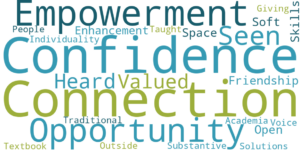
The main theme of the roundtable was the concept of enrichment. Participants were invited to describe enrichment in one or two words, beyond the dictionary definition. The responses such as ‘confidence’, ‘connection’ and ‘opportunity’ formed the central discussion of the session. This reflected a broad and deeply human understanding of what enrichment means and why it matters.
How to enrich
Participants identified that young people need reliability and consistency. Not that everything must be identical or rigidly planned, but they need to feel that they can depend on the people and structures around them. The following was discussed:
- Trusted relationships: the familiarity of adult cannot be overstated. Whether it is someone they know or are getting to know, building trust with adults is foundational
- Peer relationships: connections with other young people going through similar experiences are equally important
- Purpose beyond the programme: enrichment should not feel like a standalone event. Young people need to see a pathway to employment, to housing support, or whatever they need most at the time
- Recognition of alternative qualifications: programmes must recognise the value of qualifications and achievements for those who have fallen out of the formal education system. Focusing on what they have not done serves no one
- A different tone: enrichment must not replicate the environment in which young people have already felt failed. It should allow them to feel that anything is possible
- Holistic support: including sports, extra-curricular activities, and wraparound wellbeing support for the whole young person
- Their ‘why’: helping a young person connect to their own motivation is more powerful than any external incentive
Participants also acknowledged an important tension; whether enrichment is most effective when delivered separately from mainstream provision, or when embedded alongside it. This remains an open question that the policy toolkit should address.
How enrichment is presented to young people
The roundtable considered how enrichment is framed and communicated, and what improvements are needed. This included presenting enrichment as a level playing field, a space where prior achievement or failure is not emphasised.
Work experience, for example, is often reduced to a checkbox rather than a genuine opportunity. What matters is equipping young people with the essential skills to present themselves effectively to employers. A broader set of enrichment experiences should be made available, moving beyond traditional volunteering into areas like creative arts, sport, enterprise, and civic engagement.
Employers need to be clearer about what they value beyond qualifications and formal work experience. Employers also need to change their own language, moving away from jargon when engaging with young people.
Next steps
The session formed part of a wider research project led by academics at the University of Bath, in partnership with the DofE. It will directly inform a policymaker toolkit drawing on young people’s perspectives gathered at the roundtable including Catch22’s contribution. The toolkit will:
- Set out a clear definition of enrichment that is human-centred rather than metric-driven
- Provide guidance on the conditions necessary for effective enrichment delivery, drawing on the principles identified in this session
- Address the standardisation question offering a framework flexible enough to accommodate diverse approaches while maintaining accountability
- Include recommendations for employers, commissioners, and government on language, accessibility, and social value
- Capture the lived experience of young people
In the longer term, a peer-reviewed academic article and future research agenda will also be produced.
We look forward to seeing the outputs of this research and the difference they can make in shaping policy and practice around enrichment for young people at risk of NEET.